
A mechanical duel on the wrist, where every minute is a move and every hour ends in a decisive strike.

In a watch industry where countless new releases compete through familiar complications, vintage-inspired aesthetics and incremental technical upgrades, the GearMagus MS06 Fight Time takes a decidedly different approach. Instead of asking how to display time more elegantly, it asks a more entertaining question: what if telling time could become a mechanical performance?

The answer is an unconventional automatic watch featuring two miniature fencing figures, a dual retrograde minute mechanism and an animated display that transforms the passage of time into a perpetual duel. At $1,099, the MS06 occupies an interesting position in the independent watchmaking landscape: mechanically ambitious, visually eccentric and refreshingly unconcerned with conventional design expectations.
A Dial That Refuses to Stay Still

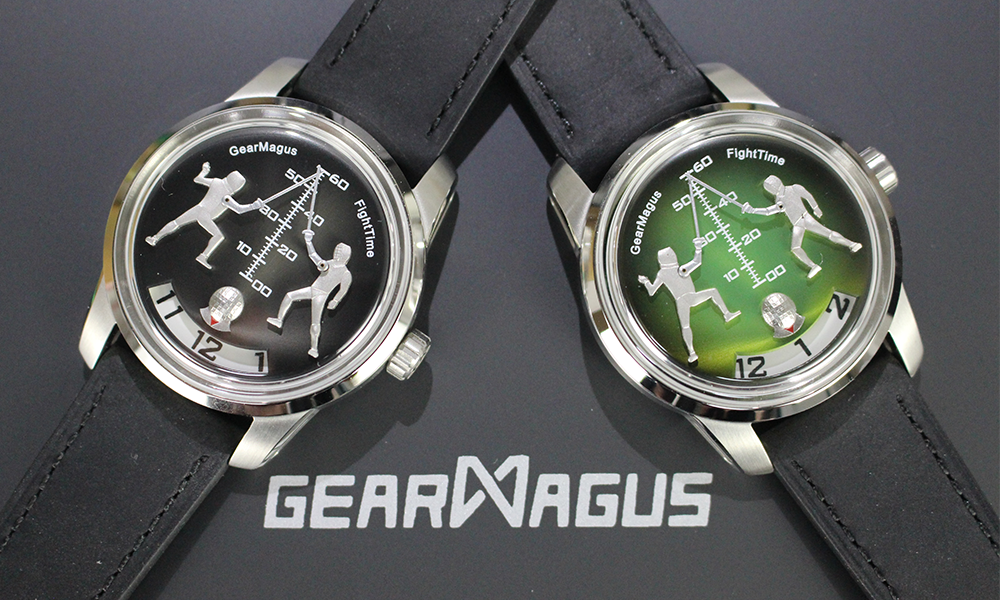
The first encounter with the MS06 is all about its dial. Two three-dimensional fencers dominate the composition, positioned on opposite sides of a central graduated scale. Their sculptural silver forms stand out against either a restrained black background or a more expressive green dial, giving the watch an almost miniature theatrical quality.

The design draws directly from the visual language of fencing. Extended arms, poised bodies and crossed swords establish a sense of movement even when the watch is stationary. The figures are not decorative additions placed on top of an ordinary dial. They are integral to the watch's mechanical identity.

The black version leans toward a technical, instrument-like aesthetic, while the green version introduces greater visual depth and a more playful personality. Both balance the polished stainless steel case with the textured, dimensional character of the dial.

There is something wonderfully unconventional about this arrangement. The MS06 looks less like a traditional wristwatch and more like a miniature kinetic sculpture that happens to tell the time.
Dual Retrograde Minutes: The Mechanics of a Duel

The real ingenuity lies beneath the spectacle.
The MS06 employs a modified SW200-based automatic movement, re-engineered to accommodate its dual retrograde minute architecture and animated fencing mechanism.

Unlike conventional minute hands that travel around a circular dial, the MS06 uses two synchronized retrograde indicators. Their corresponding swords move along graduated arcs, tracking the minutes as the hour progresses.
The defining moment arrives at the end of the 60-minute cycle. Both indicators snap back to their starting positions, accompanied by a coordinated downward movement of the fencers' swords. The mechanism resets, and another mechanical duel begins.

This is where the MS06 becomes particularly compelling. The retrograde complication is not simply a technical feature added to make the specification sheet more impressive. Its movement provides the foundation for the entire visual narrative.
The relationship between the display and the automaton gives the mechanism a clear purpose: time is represented through action rather than conventional hands.
Reading Time Becomes Part of the Experience
The MS06 also changes the relationship between the wearer and the act of reading time.
Its central minute display requires a moment of interpretation, while the hour indication sits in a separate window near six o'clock. For collectors accustomed to conventional three-hand watches, the arrangement demands a short learning curve.
Yet this slight departure from familiarity is part of the attraction. The wearer is encouraged to engage with the mechanism rather than glance at the dial and immediately move on.
There is, however, a practical trade-off. With two sculptural figures, multiple scales and moving components competing for attention, the dial is considerably busier than that of a conventional mechanical watch. Those who prioritize instant legibility may find the layout less intuitive.
For enthusiasts who enjoy unconventional displays, that complexity is precisely the point.
Case, Movement and Everyday Practicality

The MS06 comes in a 42mm 316L stainless steel case, paired with a sapphire crystal and a genuine leather strap. Its approximately 14.5mm thickness reflects the additional mechanical architecture housed inside.
The modified SW200-based automatic movement provides a familiar mechanical foundation for the watch's more unusual functions. This is a sensible approach: an established movement architecture serves as the base, while the added mechanism delivers the distinctive character.

Water resistance is rated at 3 ATM, making the MS06 better suited to everyday dry conditions than swimming or water-intensive activities.
At this price point, the established movement architecture is a practical advantage, although the proprietary retrograde and automaton module will naturally make specialist servicing an important consideration. Prospective owners should pay attention to after-sales support and the availability of qualified technicians.
Is the GearMagus MS06 Worth $1,099?
The MS06 is not competing for the same audience as a minimalist automatic watch, a traditional sports watch or a dress watch with conventional complications.
Its appeal lies elsewhere: mechanical storytelling.
At $1,099, it offers an unusually animated display, a distinctive dual retrograde mechanism and a design that is immediately recognizable. It also introduces collectors to the more experimental side of contemporary Chinese independent watchmaking.
Its compromises are equally clear. The dial is unconventional, the case has substantial wrist presence, water resistance is limited, and the modified movement introduces servicing considerations that buyers should investigate.
But the most interesting watches are often those that give collectors something genuinely different to talk about.
The GearMagus MS06 Fight Time does exactly that. It turns the passage of time into a miniature sporting contest, combining mechanical engineering with a sense of humor and theatrical imagination. In a world of watches that increasingly look alike, two tiny fencers fighting over every minute make a surprisingly convincing argument for individuality.