
Horology Planet Exhibition Series — 10
In October 2026, Beijing becomes a meeting point for Chinese imperial aesthetics, traditional craftsmanship, and contemporary design. Held at the National Foreign Cultural Trade Base (Beijing), the “Forbidden City Divine Craft” Chinese Imperial Aesthetics & Contemporary Creation Exhibition and the “Horology Planet” International Creative Exhibition bring together a range of creative works that explore the connections between Eastern cultural heritage and modern craftsmanship.
The exhibition is about more than the objects on display. It also asks how traditional art forms can continue to evolve, finding new relevance through modern materials, innovative design, and precision engineering. From decorative techniques rooted in imperial workshops to the intricacies of independent watchmaking, the works on show offer different perspectives on how the past can inform the present.
As part of this exhibition series, Horology Planet takes a closer look at the participating watch brands and the ideas behind their creations.
Langeloma: Reviving the Art of Imperial Clockmaking
For centuries, elaborate clocks occupied a distinctive place in the material culture of the Chinese imperial court. Combining mechanical timekeeping with music, moving figures, decorative sculpture, and intricate surface ornamentation, these objects were far more than functional instruments. They were expressions of technical ingenuity, artistic sophistication, and cultural exchange.
During the Qing dynasty, Chinese court clocks incorporated European mechanical principles while developing a distinctive visual language shaped by Chinese decorative arts, auspicious symbolism, and imperial taste. Gilt-bronze construction, enamel decoration, miniature landscapes, and elaborate automata transformed timekeeping into a form of mechanical spectacle.
Langeloma draws inspiration from this remarkable tradition. Under the artistic direction of Ma Xianming, the brand recreates historical clock designs and explores the technical challenges of traditional clockmaking through detailed craftsmanship and mechanical reconstruction. Its creations bring together metal casting, hand engraving, gilding, enamelwork, painting, and intricate transmission systems.
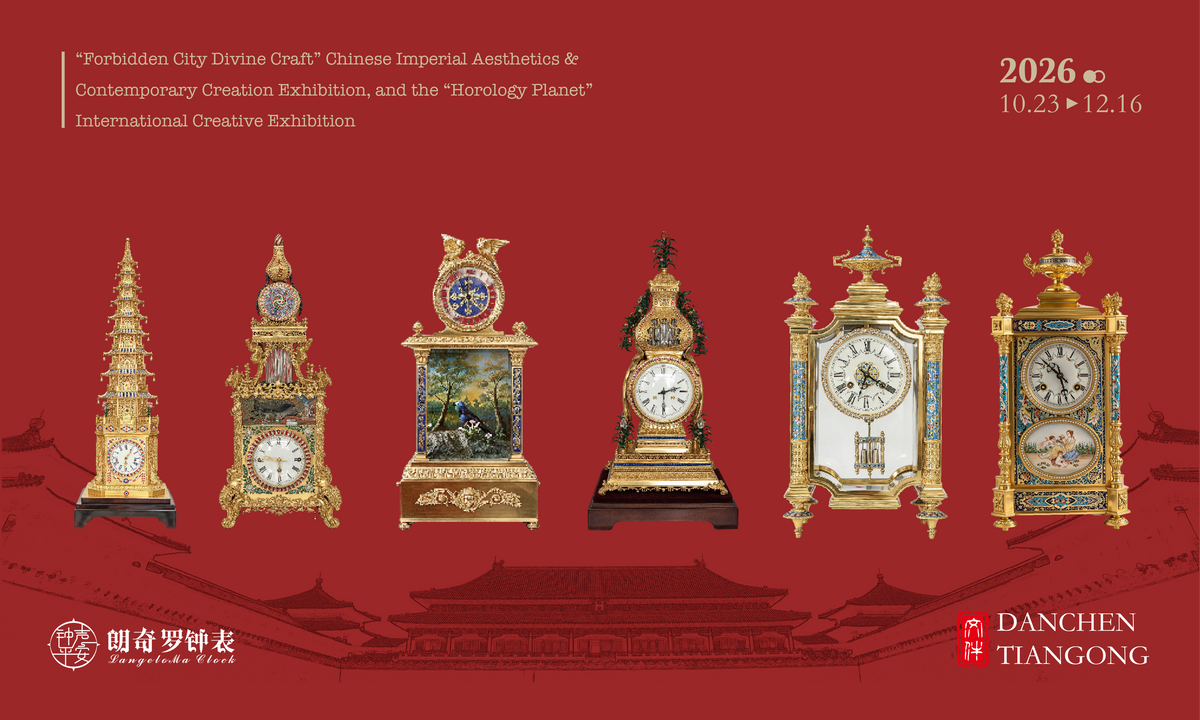
The six clocks presented here demonstrate different facets of this heritage. Some feature animated flowers and circulating waterworks, others bring mechanical birds to life through sound and movement, while ornate pagoda and pavilion clocks showcase the decorative richness of traditional court objects. Together, they reveal a world in which engineering and artistry are inseparable.
Gilt-Bronze Auspicious Gourd Clock with Rotating Flowers and Waterworks

Inspired by the elaborate mechanical clocks of the imperial court, the Gilt-Bronze Auspicious Gourd Clock with Rotating Flowers and Waterworks brings together gilded sculpture, animated floral displays, flowing water effects, and a traditional Chinese melody. Its monumental presence and intricate moving elements transform a classical decorative object into a captivating mechanical performance.
The gourd-shaped body carries auspicious associations in Chinese culture. The word hulu (葫芦) is traditionally associated with fulu (福禄), meaning blessings, prosperity, and good fortune. Here, that symbolism is expressed through a richly decorated form that combines traditional metalworking with elaborate mechanical animation.
The clock is constructed using traditional techniques, beginning with sculptural modeling and mold-making before progressing through casting, fine carving, inlay, painting, mechanical assembly, and finishing. Its exterior is cast in bronze and carefully refined before gilding. The complete mechanism incorporates more than a thousand precision components, reflecting years of development and extensive testing.
Once activated, the clock reveals an intricate animated scene. Ten small rotating flowers, set with three-colored crystal embellishments, revolve around a larger central flower within the gourd's body. The strawberry-shaped ornament at the top turns in rhythm with the music, adding another layer of movement to the composition.
Below, delicately engraved gilt-bronze columns frame a waterworks mechanism that simulates the gentle flow of a cascading waterfall. The moving water effect creates a sense of tranquility, while a lacquer painting depicting Foreign Envoys Presenting Treasures adds a historical narrative to the scene.
One of the clock's most distinctive features is its musical mechanism. Rather than relying on a conventional music box, it uses a traditional striking-bowl arrangement to reproduce Jasmine Flower (Mo Li Hua), a beloved Chinese folk melody associated with the Jiangnan region and documented in musical traditions dating to the Qing dynasty.
Ma Xianming spent two years studying the musical and mechanical challenges involved in reproducing the melody, refining the materials, tuning, and transmission system through more than a thousand practical adjustments. The result is a clock that unites moving sculpture, simulated water, and traditional music in a single coordinated performance.
Specifications
- Artist: Ma Xianming
- Dimensions: 37 × 31 × 94 cm
- Weight: 33 kg
Gilt-Bronze Gourd Clock with Waterworks

The Gilt-Bronze Gourd Clock with Waterworks draws on one of the most recognizable auspicious forms in Chinese decorative art. The gourd, associated with blessings, prosperity, and longevity, provides the foundation for a richly ornamented clock in which traditional symbolism meets elaborate mechanical animation.
Its bronze body is shaped and refined through casting, hand engraving, and polishing before receiving a luminous gilt finish. The result is a commanding decorative object whose sculptural details reflect the meticulous standards associated with classical court craftsmanship.
A pair of white porcelain clock dials occupies the lower section of the gourd, while separate winding apertures serve the timekeeping and striking functions. Above, hand-engraved scrolling lotus patterns encircle the waterfall scene. Known in Chinese decorative tradition as a symbol of enduring vitality and continuous good fortune, the scrolling vine motif adds both movement and meaning to the design.
The upper section opens onto an elaborate landscape of waterfalls and woodland imagery. A crane stands gracefully amid the scene, accompanied by blooming lotus flowers. In Chinese symbolism, the crane represents longevity, dignity, and auspiciousness, while the lotus evokes purity and refined character. Together, these motifs transform the clock into a composition rich in traditional cultural associations.
The mechanical display brings the landscape to life. When activated, the internal waterworks circulate to evoke a cascading waterfall, while the small rotating flowers around the body and the pineapple-shaped ornament at the top turn in coordination. Music accompanies the moving scene, creating a carefully balanced interplay of sound, motion, and sculptural detail.
Rather than serving as static decoration, every element contributes to the clock's overall experience. The flowing water, rotating flowers, and symbolic figures demonstrate how mechanical engineering can animate traditional Chinese decorative imagery.
Combining gilded bronze, intricate engraving, porcelain time displays, and animated scenery, this work offers a contemporary recreation of the visual richness associated with classical Chinese court clocks.
Specifications
- Artist: Ma Xianming
- Dimensions: 41 × 38 × 84 cm
- Weight: 28 kg
Gilt-Bronze Singing Bird Automaton Clock

The Gilt-Bronze Singing Bird Automaton Clock celebrates the fascination with mechanical life that characterized the great clockmaking traditions of both East and West. Combining sculptural bronze work, transparent enamel, hand-painted decoration, and a sophisticated automaton mechanism, it transforms a traditional timepiece into an animated scene of birdsong and movement.
The clock's body is made from finely finished brass, selected for its durability and suitability for detailed metalwork. The sculptural elements are produced through lost-wax casting, beginning with a modeled original before the creation of molds and the casting of the bronze components. After casting, each part is carefully refined and finished.
At the top, a pair of sculpted birds face one another with their wings spread, creating a lively focal point against the richly decorated body. The surface receives a 24-karat gold-plated finish, applied through multiple electroplating stages to achieve a warm, lustrous appearance.
Transparent enamel provides another layer of visual refinement. Applied to the dial center and columns through a combination of hand engraving and high-temperature firing, the enamel allows the underlying decorative patterns to remain visible beneath the translucent surface. This creates a subtle depth that changes with the surrounding light.
The clock's defining feature lies within its automaton mechanism. Hundreds of miniature components, including cams, gears, and levers, convert the movement of the mechanism into coordinated actions.
Once wound and activated, the clock begins with a musical passage. The small birds inside the display enclosure then produce their characteristic calls while performing a sequence of lifelike movements, opening their beaks, turning their heads, and moving their tails. The synchronization of sound and motion requires careful mechanical coordination, making the automaton an especially intricate part of the design.
Inside the enclosure, hand-painted oil paintings add depth and individuality to the decorative composition. Their nuanced colors and brushwork complement the gilded metalwork and translucent enamel, bringing together techniques associated with different artistic traditions.
Through the combination of traditional metal craftsmanship, decorative enamel, hand-painted imagery, and mechanical animation, the Singing Bird Automaton Clock demonstrates how clockmaking can become a form of kinetic art. Its appeal lies not only in its ornate appearance, but also in the engineering required to make its miniature world move and sing.
Specifications
- Artist: Ma Xianming
- Dimensions: 41 × 38 × 84 cm
- Weight: 28 kg
Gilt-Bronze Nine-Tier Pagoda Rotating Clock

The Gilt-Bronze Nine-Tier Pagoda Rotating Clock is a contemporary, one-to-one-scale recreation of a historical clock whose original is preserved at the Palace Museum in Beijing. Based on the published documentation in Qing Dynasty Clocks, page 178, the recreation reflects the considerable technical effort required to reproduce the form and animated features of an elaborate imperial-era timepiece.
Langeloma spent three years developing this second-generation model, bringing together a German Hermle movement and a specially developed mechanical transmission system. The project required close attention to the proportions, decorative elements, and coordinated movement of the original design.
The clock rises from an octagonal base into a nine-tier pagoda structure, with small bells suspended beneath the eaves of each tier. Blue and white crystal embellishments decorate the pagoda body, while additional red, white, and blue stones frame the main dial. On either side sit a thermometer and a hygrometer, adding practical measuring functions to the elaborate decorative composition.
The dial itself features an ivory-white porcelain surface fired onto a copper base, combining the refinement of porcelain with the structural strength of metal. The gilt exterior and sparkling embellishments create a richly layered appearance that recalls the opulence of historical court objects.
At the top of each hour, the clock's animated mechanism sets four flower ornaments above the main body into rotation while the clock plays Jasmine Flower. The clear, delicate melody accompanies the synchronized movement, transforming the pagoda into a miniature mechanical performance.
The original historical clock is a museum-held object, while Langeloma's version is a painstaking modern recreation. That distinction is central to its significance: the work offers collectors a way to appreciate the visual design, mechanical ingenuity, and decorative craftsmanship of a historical court clock through a newly made object.
Its combination of a traditional pagoda silhouette, layered moving elements, musical performance, and functional timekeeping makes it one of the most visually distinctive pieces in the collection.
Specifications
- Artist: Ma Xianming
- Dimensions: 43.5 × 43.5 × 134 cm
- Weight: 45 kg
Gilt-Bronze Four-Sided Pavilion Clock with Enamel Decoration

Inspired by a historical pavilion clock from the Qing imperial collection, the Gilt-Bronze Four-Sided Pavilion Clock with Enamel Decoration reflects the cultural exchange that shaped Chinese court clockmaking. Its architectural form and European-style timekeeping structure are combined with decorative techniques associated with traditional Chinese enamelwork, resulting in an object that is both mechanically functional and richly ornamental.
The clock's framework is constructed from gilded brass, with a four-sided pavilion design that allows the internal mechanism to be viewed through transparent glass panels. The open architecture draws attention to the relationship between the movement and its decorative housing, making the clock's mechanical character part of its visual appeal.
Four slender columns support the upper structure. Their deep blue enamel surfaces are decorated with scrolling floral motifs, while gilt auspicious ornaments crown the columns and the pavilion roof. The base features an intricate enamel ground pattern, adding further detail to the composition.
The decoration draws on traditional metalworking and enamel techniques, including casting, hand engraving, polishing, and the careful application of colored enamel. The combination of blue enamel and luminous gilding creates a striking contrast, recalling the elaborate decorative language of historical court objects.
At the center, a classical dial with Roman numerals is framed by ornamental detailing and a floral design. The hands and hour markers maintain a clear time display, while the mechanical movement and pendulum introduce a quieter rhythm beneath the ornate exterior. When the striking mechanism activates, the clock produces a clear, resonant chime.
The historical context is equally significant. During the Qing dynasty, the imperial court embraced European clockmaking structures while adapting them to Chinese tastes through traditional decorative techniques. Pavilion clocks of this kind embody that encounter between imported mechanical knowledge and local artistic traditions.
By recreating this form, Langeloma highlights the relationship between engineering, architecture, and decorative craftsmanship. The result is a clock designed not simply to measure time, but to occupy a place within a larger tradition of cultural exchange and artistic collecting.
Specifications
- Artist: Ma Xianming
- Dimensions: 25 × 19 × 47.5 cm
- Weight: 17.5 kg
Gilt-Bronze Enamel Clock with Painted Porcelain Panels

The Gilt-Bronze Enamel Clock with Painted Porcelain Panels draws inspiration from the refined clocks associated with the Qianlong era of the Qing dynasty. Its four-sided pavilion structure, elaborate enamel decoration, and miniature figurative paintings bring together Chinese decorative craftsmanship and the artistic influences that entered the imperial court through European clockmaking.
The clock is built around a symmetrical pavilion-shaped frame, supported by four evenly proportioned columns. The front and side surfaces are decorated with intricate engraved-ground enamel patterns, whose carefully arranged motifs and restrained color palette create a sense of classical elegance.
The enamelwork is a defining feature. Fine engraved details form the foundation for the colored decoration, creating a richly textured surface that contrasts with the warm glow of the gilt-bronze framework. The overall composition recalls the decorative sophistication of historical court clocks while emphasizing the craftsmanship involved in recreating their visual language.
Beneath the dial and along the sides, miniature painted enamel porcelain panels provide the most distinctive artistic detail. The panels depict Cupid and female figures, rendered with delicate lines, expressive gestures, and carefully controlled color. These miniature scenes introduce a narrative dimension to the clock, transforming its surfaces into a meeting point between mechanical timekeeping and figurative art.
The clock is equipped with two separate two-hand mechanisms, one for timekeeping and the other for striking. This arrangement preserves the functional logic of traditional mechanical clocks while allowing the decorative exterior to remain the visual focus.
According to the supplied historical account, the design draws on a clock associated with an imperial study in the Forbidden City. The contemporary recreation seeks to preserve the form, decorative character, and artistic atmosphere of that historical object, bringing the visual language of Qing court craftsmanship into a newly made collectible.
The combination of pavilion architecture, engraved-ground enamel, painted porcelain panels, and mechanical timekeeping reveals the breadth of artistic influences found in historical Chinese court clocks. It is a particularly clear example of how decorative arts and horological engineering can coexist within a single object.
Specifications
- Artist: Ma Xianming
- Dimensions: 21 × 18 × 44 cm
- Weight: 9 kg
—————————————————————————————————————————————————
Exhibition Guide
- Exhibition Name: “Forbidden City Divine Craft” Chinese Imperial Aesthetics & Contemporary Creation Exhibition, and the “Horology Planet” International Creative Exhibition
- Opening Date: October 23, 2026
- Exhibition Dates: October 23, 2026 – December 16, 2026
- Venue: 3rd Floor Art Space, Building D7, National Foreign Cultural Trade Base (Beijing), No. 3 Jinhang East Road, Shunyi District, Beijing
- Organizer: National Foreign Cultural Trade Base (Beijing)
- Academic Support: Research Group on Qing Dynasty Court Craftsmanship Inheritance Examples, The Palace Museum; Watchina
- Executive Curator: Horology Planet